Choosing baby toys for 6-12 months when tummy time is the problem
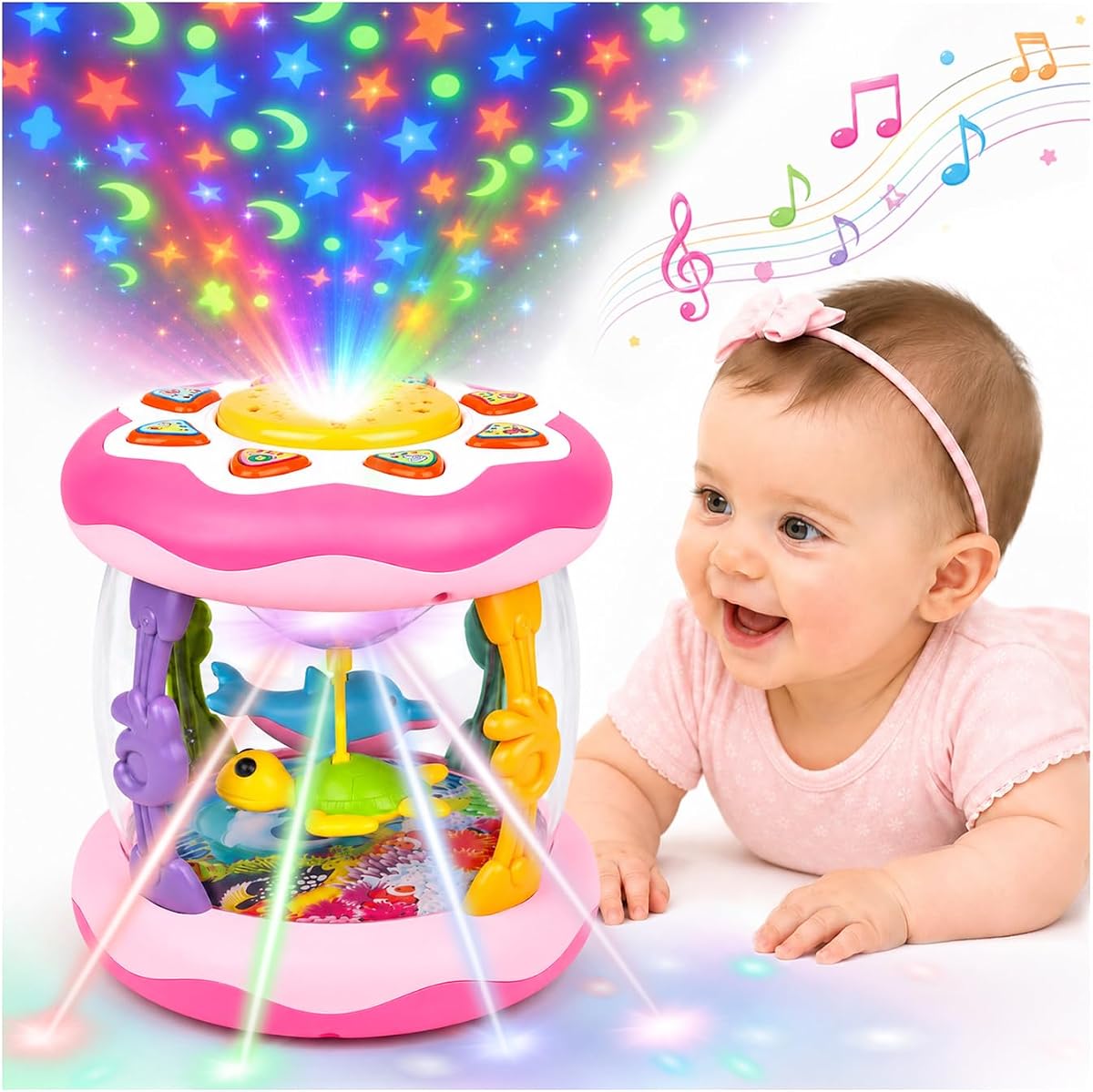
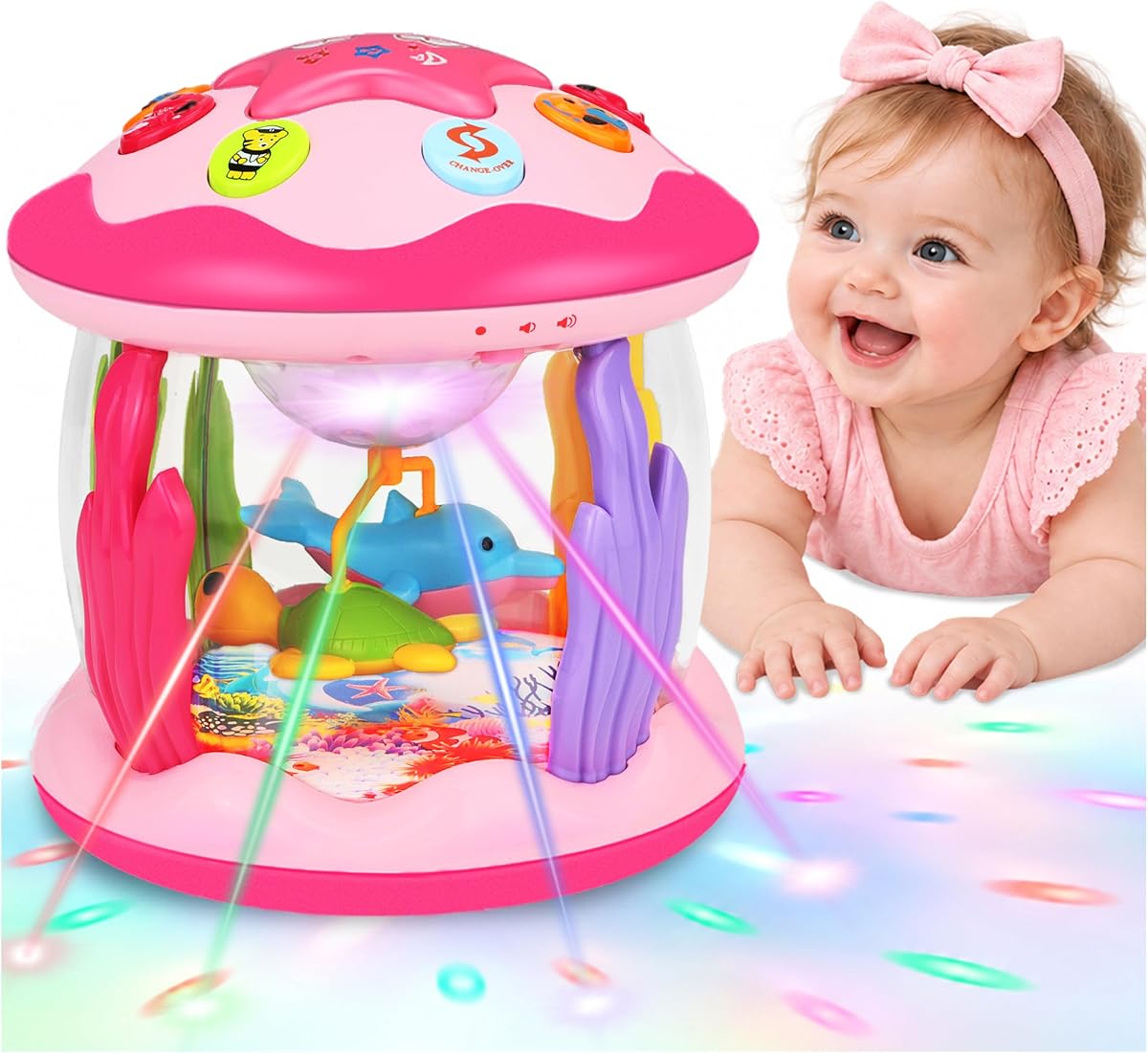
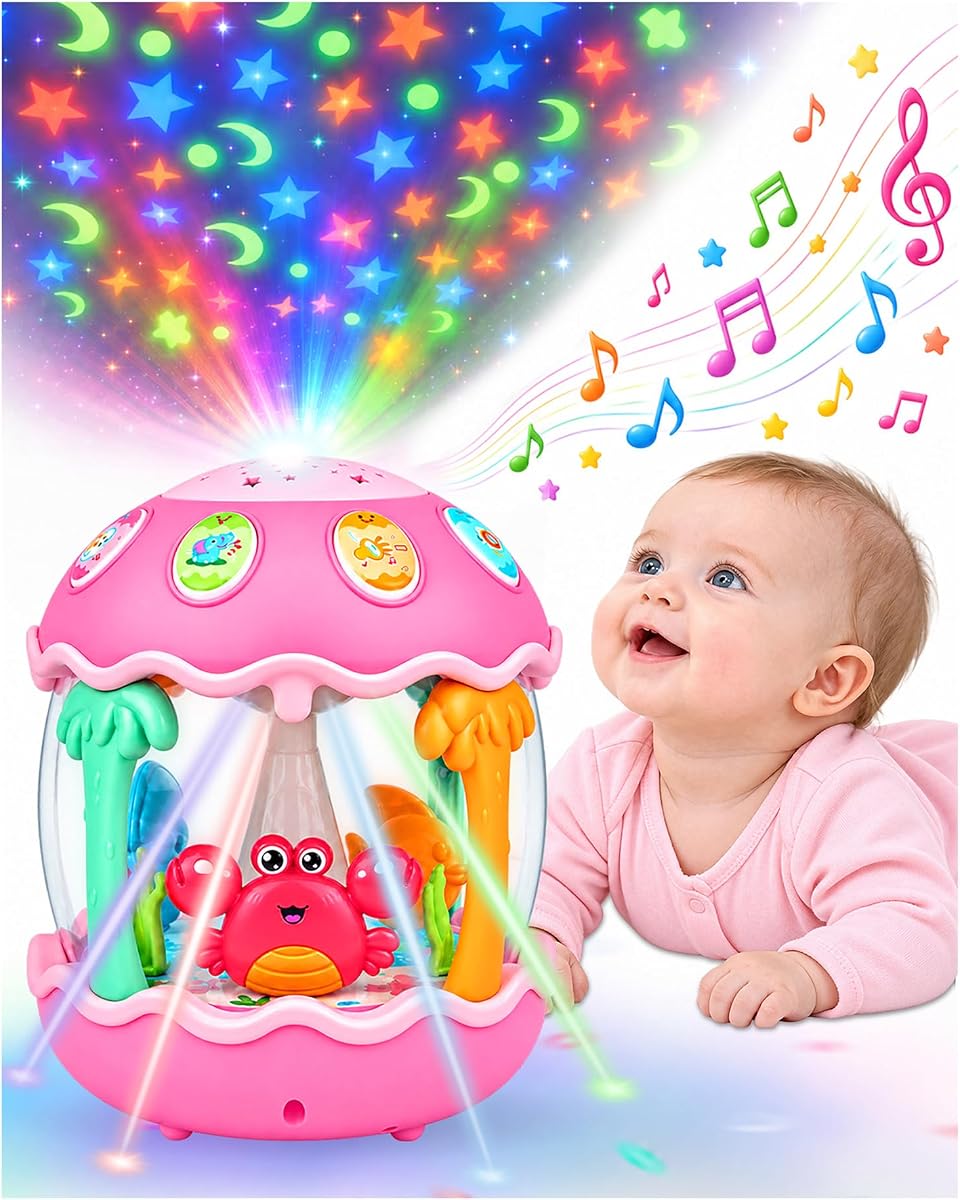
All three projectors do the same four things: they rotate, they light up, they play sound and they roll. The differences are in how much of each. The dolphin and turtle model carries the largest sound library, with ten nursery rhymes on top of animal calls and instrument tones, and it is the one we suggest when a toy is the only one being bought. The rolling projector is the quiet one, with a separate lullaby button and a shorter set of tunes, and it is the one that tends to end up beside a cot. The seven-colour model is newest and the only one with a button a baby can reach and press themselves, which changes it from something an adult operates into something a baby controls.
The case for this kind of toy is narrow and worth stating plainly. A rotating light holds a newborn's gaze, and holding a gaze is how tummy time gets extended past the first minute of complaint. Placed a hand's width beyond the fingertips, it produces a lift of the head and a reach. Later, once a baby is up on hands and knees, the wheels turn the same object into a reason to crawl. Few toys stay useful across that much development.
Two practical notes. Each projector takes three AA cells, which are not included, and the battery compartment closes with a screw on every model. Volume is adjustable on all three, and the lowest setting on each is quiet enough to leave running next to a sleeping baby.
Montessori baby toys at 6-12 months, and where a projector fits
Parents who search for montessori baby toys for 6 to 12 months arrive with a clear picture: wooden rings, a ball in a box, a grasping puzzle cut from wood. That picture is a fair one, and a shelf built only from those objects will serve an infant well. A rotating projector is not one of them, and we are not going to argue that it is.
What a projector does is buy minutes. Montessori work at this age depends on a baby being on the floor, on the front, with both hands free, and the hardest part of that for most families is the first fortnight of tummy time. A slow light holds a gaze, a held gaze lifts a head, and a lifted head is the movement everything else is built on. Used for ten minutes at a time rather than as background, the toy supports the same development a wooden material does.
What changes between six and twelve months old
Those months are not one stage, they are four, and knowing which one a baby is in tells you more than any age printed on a box.
- Six to seven months. Tracking is smooth and a hand reaches on purpose. Contrast and movement hold attention far better than detail does.
- Eight to nine months. The grasp turns fine, objects transfer between hands, and letting go becomes deliberate. Stacking and filling start to make sense.
- Ten to eleven months. Crawling turns the room into a world. Something that rolls away is now a reason to move.
- Twelve months. Pulling to stand and cruising, with cause and effect play repeated until an adult gives in.
All three projectors sit across that whole span, which is unusual for one object. The same toy is a thing to look at in the sixth month, a thing to reach for in the eighth, and a thing to chase in the tenth.
Balancing light and sound with quiet objects
A sensible shelf for this age holds about six things and only one of them needs a battery. The rest should be real objects with real weight: a wooden ball, a set of rings, a cup to fill and empty, a mirror at floor height, two board books, a soft box of textures. Put the projector in that company and it earns its place. Leave it running alone in a dark room and it stops being a toy and becomes television.
The practical test we use is simple. Does the baby act, or does the baby watch? A toy that promotes action belongs on the shelf. One that only performs belongs in a cupboard most of the week.
Questions about these toys
Do projectors help motor skills or only attention?
Both, indirectly. The reach and the head lift are gross motor work, and the chase that starts once crawling arrives is the best movement practice there is. Fine motor skills come from the quieter objects on the shelf.
Is this a good first toy for a newborn?
It is one of the few things on this site that works before six months, because tracking a slow light is something a very young baby can already do.
Will the sound wake a sleeping baby?
Volume is adjustable on all three and the lowest setting on each is quiet. We would still keep the toy in the room where play happens rather than beside a cot.
What else belongs on the shelf beside a projector
If a projector is the one toy with a battery, the rest of the shelf should be quiet. A set of wooden rings on a peg, a stacking kit of nesting blocks, a ball that rolls but not far, a cup, a low mirror, two board books and a little box of natural objects will carry a baby from six months into the toddler year. That is seven items and it is enough.
Each of those encourages something specific. Rings build the pincer grip and fine coordination. Blocks introduce size order and the beginnings of building. A wooden egg in a cup is the simplest container puzzle there is, and children find it endlessly worth repeating. Books give language. A mirror gives self recognition, which is a genuine developmental event rather than a marketing line. None of it is expensive and none of it needs explaining.
The projector earns its place by doing the one thing that list cannot: it moves. For a baby who has not yet learned to explore, movement is the invitation. Once exploring starts, the quiet objects take over and the projector becomes the toy for the awkward half hour before a nap. Quality here is not about price, it is about whether an object will still be in use in six months. Most of the kids we hear about keep the wooden things and lose interest in everything else, and that is the right way round. Montessori toys age well for exactly that reason.